
Morawaka
மொரவக்கMoravaka
Mora+waka
The side of Mora trees (Nephelium longanum)
| Waka | From Wakkang: Part, portion, share (Sinhala); Vaakkam: A place name suffix meaning, side, surroundings, adjacent area, locality etc. (Tamil, especially coastal areas around Chennai); Paakkam: A neighbouring hamlet, fishermen’s colonies (Pre-Pallavan Tamil Index); A hamlet (Tamil, Changkam Diction, Mathuraikkaagnchi 137); A hamlet of the hill tract (Tamil, Changkam Diction, Ku’runthokai 339:2-3); A hamlet of the coastal tract (Tamil, Changkam Diction, Natti’nai 111:9); Village, seaside village, town (Dravidian Etymological Dictionary 4047); Vaku: (verb) To divide, separate, apportion; Vakuppu: (noun) Section, division (Tamil, Dravidian Etymological Dictionary 5202); Vakukka: (verb) To divide; Vaka: Division, property (Malayalam, Dravidian Etymological Dictionary 5202); Paku: (verb) Divide, separate, split; Pakal: (noun) Dividing, share; Pakir: (noun) Share, section, piece, portion; Pakuthi: (noun) Portion; Pangku: Part, share (Tamil, Dravidian Etymological Dictionary 3808); Paangkar: Side, neighbourhood (Tamil, DED 4053) |
| Mora | A tree producing sweet or sub-acid fruits, Nephelium longanum (Sinhala); Murali, Mura’li, Nurai: Name of the same tree in Eezham Tamil (See column on Nuraichchoalai) |
As could be seen from the table above, the Sinhala place name suffix Waka is a cognate of the Tamil place name suffixes Vaakkam and Paakkam and the Malayalam term Vaka. All of them are Dravidian and are derivates of the verb roots Vaku and Paku (V and P interchange, Dravidian Etymological Dictionary 5202, 3808).
But, there are interesting points of observation.
The Sinahala place name suffix Waka mostly occurs in the southern and hilly parts of the island where as the Tamil suffix Vaakkam is found in the coastal areas of northern Tamil Nadu. Neither Vaakkam nor Paakkam is found in Eezham Tamil place names.
In contemporary Tamil Nadu Vaakkam and Paakkam are generally considered as suffixes of coastal place names. Only in the Changkam Tamil literary traditions Paakkam comes as a toponymic suffix of the hill country (Ku’runthokai 339: 2-3), in addition to the coastal tract. It also generally means a village in the Changkam literature. More interestingly, the closest parallel to the Sinhala term Waka, with identical shade of meaning, is found in the Malayalam term Vaka.
The suffix is one of the many examples for the presence of a Dravidian substratum in the Sinhala place names and its close relationship with old Tamil and Malayalam.
See column on Nuraichchoalai for discussions on the prefix of the place name Mora, which is a tree producing sweet or sub acid fruits (Nephelium longanum).
Morawaka, a part or side of land that was once having the Mora trees, became a rubber plantation and is now a tea estate in the Matara district of Southern Province.
Some related place names:
Sita-waka: (S’eeta-waka): The cool side or the chilly side. Another possibility is that the side or part was named after one of the following plants: Cordia myxa, a small tree; Aloe vulgaris, a sort of aloe; or Marsilea quadrifolia a plant also called Diya-æmbul æmbiliya. Sitawaka is near Avissawella in the Colombo district of Western Province. It was the capital of a kingdom in the 16th century.
Dena-waka: The side of cowherds (pasture land) or the part that was bestowed. This is a place near Pelmadulla in the Ratnapura district of Sabaragamuwa Province. There are two parts of the place; Uda-kada, the upper part and Pata-kada, the lower part (Kade: Side; Kannada, Dravidian Etymological Dictionary 1109; Pathi: Be low-lying as land; Pathivu: Depression, Tamil, DED 3911)
Some place names around Chennai:
Purasai-vaakkam: The side, part or locality of Purasu trees
Puzhuthi-vaakkam: The side or part of dusty earth.
Koddi-vaakkam: The side where Koddi yam grows
Ma’n’ni-vaakkam: The sandy side
Paakkam in Changkam literature:
- Village in general: “Kad ko’ndik-kudip-paakkaththu…” (Mathuraikkaagnchi 137)
- Village in a hilly place: “Chaaral ku’ravar paakkaththu izhitharum…” (Ku’runthokai 339: 2-3)
- Village in a coastal place: “Perungkazhip-paakkam kallena..” (Natti’nai 111:9)
First published: Friday, 20 August 2010, 22:44
Nuraichchoalai
நுரைச்சோலைNuraiccōlai
Nurai+choalai
The grove of Nurai (Murali) trees (Nephelium longanum)
Revised: Thu, 01 Nov 2007
| Nurai | (Eastern Province Tamil dialect), Murali, Mura'li (Vanni Tamil dialect), Mora (Sinhala): A tree, bearing fruits similar to lychee. Dragon's Eye, Soapberry, Nephelium longanum, Dimocarpus longan, Euphoria longan, Euphoria malaiensis, Euphoria sinensis, Euphoria verruculosa of the Sapindaceae family |
| Choalai | Grove |

Nurai / Murali / Mora (Nephelium longanum / Dimocarpus longan): A matured tree [Courtesy: TopTropicals.com]

Nurai / Murali / Mora: foliage [Courtesy: aycronto.com]

Nurai / Murali / Mora: Flowering [Courtesy: TopTropicals.com]

Nurai / Murali / Mora: Unripe fruits [Courtesy: TopTropicals.com]

Nurai / Murali / Mora: A bunch of ripe fruits [Courtesy: usda.gov]

Nurai / Murali / Mora: Leaves, fruits and seeds [Courtesy: montosogardens.com]

Nurai / Murali / Mora fruits: Peeled skin and translucent flesh [Courtesy: Wikipedia, photo by Surukuku (Nelson Ramos-Lopes)]

Nurai / Murali / Mora fruit: Cross section [Courtesy: Wikipedia, photo by Surukuku (Nelson Ramos-Lopes)]

Nurai / Murali / Mora: Stem and bark [Courtesy: botanypictures.com]

Nurai / Murali / Mora: As a pruned and cultivated crop [Courtesy: TopTropicals.com]

Nurai / Murali / Mora in the Alamany Farmer's Market, U.S.A [Courtesy: Plantworld.org]
It is considered to be a native of Southern China, Southeast Asia including Assam of India, Southwest India (Western Ghats of Tamil Nadu and Kerala) and Sri Lanka. It is widely found in Sri Lanka in the dry zone as well as wet zone forests.
The tree and its fruit are known by various names: Nurai in the Eastern Province of Sri Lanka, Murali or Mura'li in Vanni, Mora in Sinhala, Chem-poovam / Chem-poovan / Kaaddup-poovam in the dialects of Tamil Nadu, Mata-kuching in Malaysia, Leng-keng in Indonesia, Lung-ngan (Dragon's Eye) and Pin-yin (Round Meat) in Chinese.
This shady tree of dark green foliage can grow up to 50 feet. It bears fruits between July and September. The fruits appear in bunches and in abundance. A matured tree can produce up to 200 kg of fruits in a season.
In tropical environs, the fruiting cycle of the tree is erratic. A gap of a couple of years or more could be there in between two occasions of good yield. This is noticed in Sri Lanka too. But, the saying in Vanni that the tree bears fruits only once in twelve years is an exaggeration.
The globular fruit of unique flavour and sweet taste has a thin brown skin, which can be peeled easily. The flesh is translucent, containing a hard, shiny black seed, which is white at its base. The seed and the flesh also can be separated easily. The fruit resembles very much the lychee, but is smaller in size. It is often considered a poor cousin (little brother or slave in the Chinese accounts) of lychee (Nephelium litchi / Litchi chinensis).
When the skin is removed, the black seed, seen through the white translucent flesh, make the fruit to look like an eyeball. The Chinese term Lung-ngan and its rendering in English Dragon's Eye, along with another English name Cat's Eye, have come from this feature of the fruit.
The powdered seeds when mixed with water produce foam. This can be used as Shampoo. The Tamil term Nurai, prevailing in the Eastern Province of Sri Lanka seemed to have originated from this attribute of the seeds. Nurai means foam in Tamil. Note that one of the English names for the tree is Soapberry.
The Vanni Tamil term Murali and the Sinhala name Mora for the tree and its fruit seem to be cognates sharing common origins.
Probable old Tamil words of etymological connection from the Changkam diction are Muruku and Murunthu. Relevant shades of meaning for Muruku are honey, toddy and pleasant smell. Murunthu is whiteness or tender white sprout. The Sinhala words Meeraa (sweet toddy), Meerita (sweetness) and the Dhivehi (Maldivian) word Meeru (sweetness) also can be brought in here for comparison. Another obsolete Tamil word that can be cited is Ma'rukai, which is a synonym for Nungku, the sweet jelly of the seeds of tender palmyra fruit (Winslow's Tamil Dictionary). Nungku resembles the translucent flesh of Nurai / Murali fruit.
Ethnological writings of the colonial times record that the Veddas of Sri Lanka used the bark of the Mora tree as a substitute for arecanut (John Baily, 1863). This could be an evidence to assign Sri Lanka as one of the natural habitats of the tree.
It is one of the sacred trees protected in the Kaavus (sacred groves) of Kerala.
The Murali fruit in its wild settings of Vanni is immortalized in Nilakki'li, a significant Sri Lankan Tamil novel written by Balamanoharan in the early 1970s.
The fruit still remains wild in Sri Lanka, whereas elsewhere it has become a cultivated crop of export potentialities. The domesticated trees are induced by environmental control, irrigation and chemicals to bear fruits in abundance every year. The trees are pruned for keeping at reachable height. The produce is refrigerated, canned and dried for marketing. The fruit is a good source of potassium and is low in calories.
In herbal medicine, especially in the Chinese school, the produces of the tree are used in the treatment of a wide range of ailments, fever, insomnia, allergies, diabetes, cardiovascular complaints and so on.
The wood is used in making furniture.
Choalai, the suffix of the place name, meaning grove, is an old Tamil word of Changkam diction (Natti'nai as well as Chilappathikaaram and Ma'nimeakalai).
Nuraich-choalai is a village in the Aalim Nakar GS area of the Akkaraippattu division of Ampaa'rai district.
Examples of Related Place Names:
Chinna-nuraich-choalai: The small grove of Nurai trees. It is a village in the Kudumpimalai GS area of the Koa'ra'laippattu division of Batticaloa district.
Morak-koddaagn-cheanai: The slash and burn fields having the stump of Mora trees. A GS area in the Koa'ra'laippattu division of Batticaloa district
Mora-wewa: The tank of Mora trees. A divisional headquarters in the Trincomalee district.
Mora-gaha-pa'l'lama: The shallow area/water source of Mora trees. A GS area in the Damana division of Ampaa'rai district
Mora-deniya: The place of Mora trees. A GS area in the Padiyathalaava division of Ampaa'rai district
Mora-goda: The hillock/elevated land of Mora trees. A place of two GS areas in the Gampaha division of Gampaha district
Mora-golla: The grove of Mora trees. The name is found in several places as GS areas: Pathahewaheta division (Kandy district), Galewela division (Matale district), Naula division of Matale district, Hanguranketha division of Nuwareliya district, Kotavehera division of Kurunegala district, Ganewatta division of Kurunegala district, Panduwasnuwara division of Kurunegala district and Soranathota division of Badulla district.
Mora-yaaya: The expanse of Mora trees. A place of two GS areas in the Weeraketiya division of Hampantota district

Canned Nurai / Murali / Mora fruits among other such items [Courtesy: 21food.com]

Nurai / Murali / Mora fruits as Chinese dessert or sweet soup [Courtesy: flickr.com]

Nurai / Murali / Mora: Marketed as dried fruit [Courtesy: 21food.com]
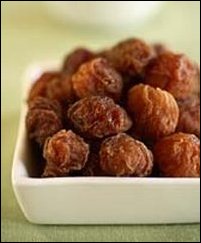
Nurai / Murali / Mora: Dried fruit [Courtesy: jupiterimages.com]
First published: Wednesday, 31 October 2007, 01:24


.jpg)
.jpg)
.jpg)