

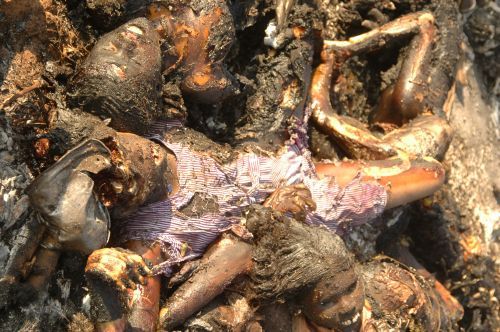
Photographic Evidence of sample wounds 
Since
the Government of Sri Lanka has banned access for all the Independent
monitors, Humanitarian Workers, including UN and the media, in the
combat zone were being isolated from the out side world, War Without
Witness regrets that a comprehensive forensic/chemical analysis report
could not be produced at that point of time.
"War Without Witness urgently urge silent partners of Sri Lankan Government’s war on innocent Tamil civilians including United States of America, India, United Kingdom, China, Japan, Norway, Australia and United Nations to immediately dispatch independent observers to the war zone and ensure the safety of civilians by way of an immediate ceasefire and independent inquiry into this war crime. War Without Witness urgently urge independent organisations like Organisation for the Prohibition of Chemical Weapons (OPCW), US Bureau of International Security and Nonproliferation, UKs Department for Business, Enterprise & Regulatory Reform (BERR) and all 186 OPCW Member States to immediately dispatch independent observers to the war zone and ensure the safety of civilians by way of an immediate ceasefire and independent inquiry into this war crime."
This
appeal was made when death and destruction was taking place in Vanni,
but there were no takers. Preliminary investigations showed the
chemicals used and it was reported as follows.
Extracts of Medical/Chemical Report Chemical Substances found on the wounds are,
Interview with those victims’ led to the conclusion that these were types of Mustard Gas attack delivered via high explosive rocket launchers and aerial bombing. Some of the observations among the victims were ‘high vomiting’, ‘mustard-coloured blisters’, ‘closed throats’, ‘breathing difficulty’ and ‘extreme pain’. Please view the tube and the download below.
|
The LTTE on 16 August 2001 accused Sri Lanka


of purchasing a banned chemical weapon and
warned of “dangerous consequences” if it was
inducted in the battlefields of northeastern Sri Lanka.
The LTTE statement appeared to refer to the
Russian- manufactured RPO-A Shmelrocket
launcher without naming it. The Sunday Leader newspaper reported that week that the
Government had purchased 1,000 units of the weapon. The Hindu news papers
confirmed it.
The Sri Lankan Army spokesman, Brig. Sanath Karunaratne, confirmed the purchase of
The Sri Lankan Army spokesman, Brig. Sanath Karunaratne, confirmed the purchase of
the Shmel, but denied it was a chemical weapon or that it was banned. The RPO-A Shmel
is a rocket-propelled incendiary/blast projectile launcher whose warhead contains a
“thermobaric” flammable mixture, that is, it simulates high pressure conditions when
detonated in enclosed structures and in the open. The use of this weapon by the Russian
Army in Chechnya came in for strong criticism by the human rights groups. The Sri
Lankan Army higher officials were seen wearing mask to protect themselves
from the fumes. The casualties of the attack remained unknown; however the
number was expected to exceed at least 1500 Tamils civilians.
The Sri Lankan Army, immediately after 19 May 2009, cleared the whole area to
destroy all evidence of death and destruction and cremated all the bodies.
Normal practice is to hand over the bodies to the Red Cross or similar
organisations, but this happened to be a 'War without Witness.'
It is now (15.09.2013) reported the Syrian army had succumbed to the threats of
US and agreed to surrender their arsenal of chemical weapons. Why was this not
done against Sri Lanka. The war could have been brought to an end earlier and
countless lives could have been saved
This could not be done as Bush's 'War on Terror' was in process and Sonia Gandhi's
war on Prabhakaran with the aid of Karunandhini should proceed unabated.
India considered the civilians, who stayed in Vanni, as pro-LTTE and the whole
lot of them had to be wiped out. They were fully aware of what was going on in
Vanni especially when their soldiers were on the ground, but kept silent.
Sonia Gandhi's anger with Prabhakaran is for killing Rajiv Gandhi is another Indian
bull-shit. The people who killed Rajiv Gandhi are still walking around in India.
Even if Rajiv had been killed by the guard of honour in Colombo in 1987, Sonia or
India wouldn't be so annoyed. The whole matter would have been solved
diplomatically. Rajiv's hurried signing of the Indo-Sri Lankan Accord in 1987 with
the unworkable 13th Amendment in it, was to see that Eezham was not created. All
the Militants agreed to go along with Rajiv, except for LTTE; hence their annoyance
with Prabhakaran, LTTE and people associated with the LTTE. That was why India
aided and abetted the Sri Lankan armed forces - as you will see in the u-tube - and
was silent when the slaughter was going on in Vanni.
Now India is against having independent international investigation into war crimes
trial in Sri Lanka. India has already saved Sri Lanka in the two UNHRC in Geneva
twice in 2012 and 2013. Will it be successful in 2014 is left to be seen.
Now it is not too late to investigate the use of chemical weapons in Sri Lanka when
war crime trial starts. It is a duty of every Tamil in the world to see that this is done.
Failure to do so is an insult to the dead.




No comments:
Post a Comment